Here is the short answer most pricing guides bury: in 2026, most self-paced online courses sell for between $100 and $500, mini courses cluster around $27–$147, and cohort-based or high-touch programs run $500–$2,000+. The right price for your course depends on the outcome you deliver, what your niche already pays — and one factor almost every guide skips: how much of each sale your platform lets you keep.
This guide covers all three: the real benchmarks, a four-step framework for picking a number, and the fee math that quietly decides your margin.
What online courses actually sell for in 2026
Industry surveys land in a fairly tight band. SellCoursesOnline’s analysis of more than 132,000 courses put the average price at $137, while BuddyBoss’s 2026 pricing guide pegs the average at $182 — a range wide enough to include everything from $10 marketplace courses to five-figure executive programs.
Platform blogs quote similar tiers. Kajabi’s pricing guidance puts mini courses at $47–$147 and signature courses at $197–$997; Circle’s puts entry-level self-paced courses at $50–$200 and cohort-based programs at $500–$2,000. Put together, the market looks like this:
| Format | Typical 2026 price | What buyers expect |
|---|---|---|
| Mini course (1–2 hours) | $27–$147 | One specific skill or quick win |
| Flagship self-paced course | $100–$500 | A complete transformation, at their own pace |
| Premium / certification course | $500–$1,000 | Depth, credibility, and proof of completion |
| Cohort or coaching hybrid | $500–$2,000+ | Live access, feedback, and accountability |
Treat these as anchors, not answers. A $79 course can be overpriced and a $1,500 course can be a bargain — it depends entirely on the outcome.
A four-step framework for pricing your course
1. Price the outcome, not the hours
Two hours of video that teaches someone to land a $10,000 raise is not a $20 product. Buyers pay for the distance between where they are and where your course gets them. Write the transformation down in one sentence (“After this course, you will be able to …”), then ask what that result is honestly worth to the person achieving it. A useful ceiling: charge no more than about a tenth of the tangible value you can defend.
2. Benchmark your niche, not the whole market
Search for the three courses your ideal buyer would actually compare you against and note their prices — not to match them, but to understand the expectations you are walking into. If everyone in your niche charges $99, a $499 course needs visibly stronger proof: better outcomes, a sharper promise, testimonials, or a guarantee.
3. Do the fee math before you commit
Your sticker price is not your revenue. Between platform transaction fees, subscription costs, and payment processing, two creators charging the same $200 can take home very different amounts. The next section shows exactly how much this matters — run your own numbers before locking a price.
4. Validate with a real cohort
Pick a founding-member price (typically 30–50% below your target), sell to your first 20–50 students, and watch two numbers: conversion rate and refund rate. Strong sales with zero pushback usually means you priced low; crickets usually means the promise — not just the price — needs work. Raise the price for the public launch and let the founding cohort become your testimonials.
A worked example: picking your number
Here is the framework applied end to end. Maya teaches watercolor portraiture — a passion skill, so the tangible-value ceiling is modest. Her one-sentence transformation: “After this course, you will paint a portrait you are proud to frame.” The three courses her buyers would actually compare her against sell for $89, $129, and $180, so the niche expects a flagship in the low hundreds.
She drafts $149 and runs the fee math on a target of 100 sales ($14,900). On a 7.5%-fee starter plan she would hand over $1,117 of it in platform fees; on a 2%-fee plan, $298 — a difference that would pay for her email tool for two years. Number in hand, she opens a founding cohort at $89 (40% off), sells 34 seats in ten days with two refunds, and banks the testimonials. Next intake, the course goes public at the full $149 — anchored by a $349 tier that adds two portfolio-review calls.
Every number above came from the four steps in order: outcome first, niche benchmarks second, fee math third, a validating cohort last. Your inputs will differ; the order should not.
The fee math nobody shows you
Here is the part most pricing guides skip, usually because the platform publishing the guide charges the fees in question. Suppose you sell a $200 course to 100 students — $20,000 in sales. Before the money reaches you, two costs come out: your platform’s transaction fee and payment processing (typically around 2.9% + 30¢ per card transaction in the US).
| Where you sell | Platform fee on sales | Fee cost on $20,000 |
|---|---|---|
| Teachable Starter ($39/mo) | 7.5% | $1,500 |
| Skool ($9/mo plan) | 10% | $2,000 |
| Podia Mover ($39/mo) | 5% | $1,000 |
| CourseKit Free ($0/mo) | 5% | $1,000 |
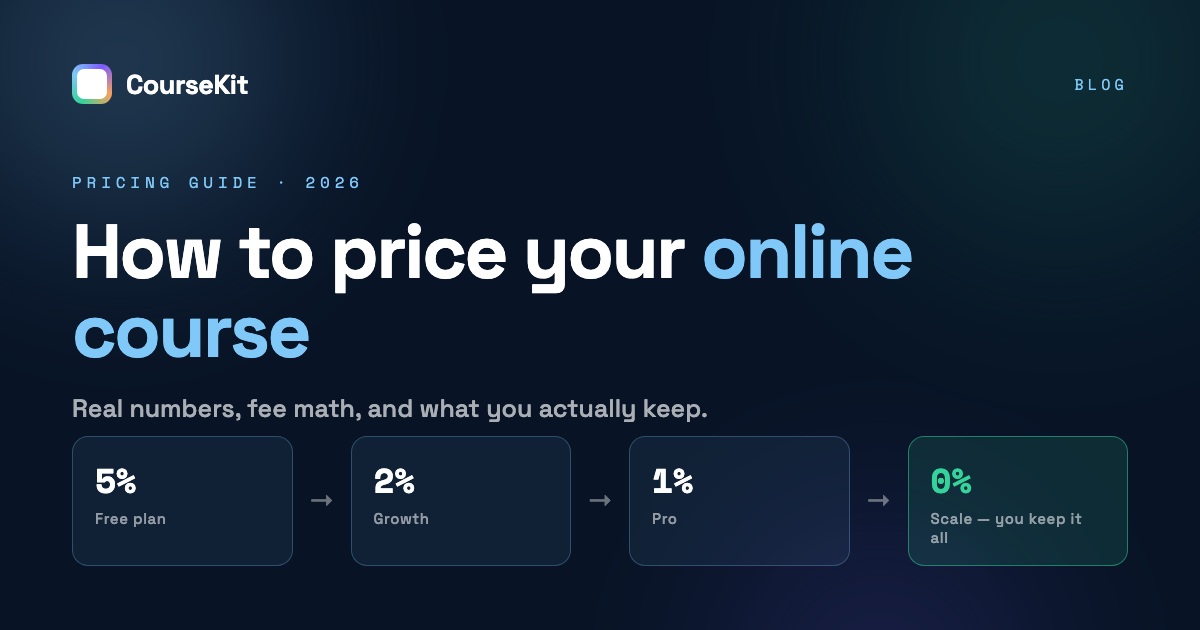
| CourseKit Growth ($99/mo) | 2% | $400 |
| CourseKit Scale | 0% | $0 |
Fee rates above are each platform’s published entry-plan rates as of August 2026 — see our full platform comparison for the details and exceptions. The pattern to notice: percentage fees scale with your success. A 7.5% fee is $75 on your first thousand dollars — and $7,500 on your first hundred thousand.
Two practical rules follow. First, if you are pricing low (under $50), percentage fees and per-transaction processing costs eat a disproportionate share — low-ticket strategies need low-fee infrastructure to work at all. Second, as volume grows, a flat monthly price with a falling fee beats a cheap plan with a high fee. You can run your own numbers with our fee calculator — it compares what you keep at any revenue level.
Pricing psychology that actually moves the needle
Charm endings still work. $197 reliably outsells $200 in course markets — not because buyers are fooled, but because course prices ending in 7 and 9 are the category convention, and matching convention reduces friction.
Anchor with a higher tier. A single price stands alone; two or three tiers give buyers a comparison. A $497 “course + feedback” tier makes the $197 core course feel like the sensible middle choice — and some buyers will genuinely want the bigger tier.
Payment plans widen the funnel. For anything above roughly $300, offer 3–6 monthly payments totaling 10–20% more than the one-time price. Podia’s own data found payment plans offered on roughly one in five courses priced over $100 — they exist because they convert buyers who believe in the course but not in their cash flow this month.
Membership or one-time price?
A one-time price sells a finished transformation; a membership sells ongoing access — community, live calls, a growing library. The economics differ more than most creators expect. One hundred students at $200 is $20,000 once; one hundred members at $29/mo is $2,900 every month, but only for as long as they stay — and memberships wrapped around finite content churn quickly once members finish the material. With recurring pricing, retention, not acquisition, becomes the job.
The practical test: if your material is a defined journey with an end (“paint a portrait you are proud of”), price it one-time. If the value genuinely renews — fresh templates monthly, an active community, live coaching — a $9–$49/mo membership can out-earn a one-time course within a year. Many creators land on the hybrid: a one-time flagship course plus an optional membership for continued community access and live sessions. (Both models run on the same CourseKit infrastructure, so you can add the membership after the course proves itself.)
Discounting, raising, and the $47 trap
The math on cheap courses is brutal. To make $10,000, you need 213 sales at $47 — or 21 at $497. Unless you have a large audience or paid-traffic engine, the higher-priced, higher-touch course is usually the more realistic path. Kajabi’s pricing team makes the same argument to its own creators: chronic underpricing costs more than it protects.
Prefer launch windows and founding-member pricing over recurring discounts. A course that is permanently 40% off trains your audience to never pay full price. And when demand is strong — waitlists filling, cohorts selling out — raise the price for the next intake rather than adding seats; announce the increase in advance and let it create urgency honestly.
Common pricing mistakes
- Pricing from your own wallet. You are not your buyer. Price for the value to them, not what you would pay.
- Competing on cheapness. The lowest-price course signals the lowest-value outcome — and attracts the most refund-prone students.
- Ignoring fees until payout day. Do the fee math at pricing time, not after your first payout surprises you.
- Skipping the payment plan. Above roughly $300, a missing 3–6-month plan quietly filters out buyers who wanted in — offer one, and let its total run 10–20% higher than the one-time price.
- Never revisiting the number. Each launch is new information. Revisit pricing every intake, not every few years.
Online course pricing FAQ
How much should I charge for my first online course?
For a first flagship course, $100–$300 with a founding-member discount for the first cohort is a defensible starting range — high enough to signal value and fund improvement, low enough to convert an early audience while you gather results and testimonials.
What is a good price for a mini course?
Mini courses typically sell for $27–$147. Their job is usually not profit — it is turning subscribers into buyers who later purchase your flagship course, so err toward the accessible end.
How much does it cost to create an online course?
For most first courses, somewhere between $0 and $1,500 — far less than the polished-studio numbers suggest. A modern phone camera, natural light, and free editing software produce perfectly sellable lessons; the spends that actually matter are a decent microphone (roughly $100 — buyers forgive average video but not muddy audio), your platform’s monthly fee, and perhaps a cover design. Treat everything else as optional until revenue justifies it: a validated promise recorded simply outsells a cinematic production nobody asked for, and every dollar not spent on gear is a dollar your first launch does not have to earn back.
Are online course prices going up?
At the premium end, yes — cohort-based and outcome-focused programs keep pushing upward, while low-ticket marketplace courses stay cheap. The middle is thinning: courses win either on accessibility or on depth, not by splitting the difference.
How do platform fees change what I should charge?
On a high-fee platform, a meaningful slice of any price you choose is not yours. Either price with your platform’s cut explicitly budgeted, or move to infrastructure where the fee falls as you grow — on your own site, every dollar of a price increase is yours to keep. Our guide to selling online courses covers choosing that infrastructure step by step.
How low is too low for an online course?
Below roughly $30, a flagship course starts working against itself: buyers read the price as a verdict on the content, you cannot afford paid acquisition, and fixed costs bite hardest — card processing’s ~30¢ per transaction plus any platform percentage consume a visibly larger slice of a small price. Reserve low prices for mini courses and lead magnets, where the goal is the relationship rather than the revenue.
When should an online course be free?
Free courses earn their keep as funnels, not products: a taster that promotes a paid flagship, a lead magnet that grows your email list, or onboarding that reduces refunds on something bigger. If a free course is doing one of those jobs, it should live where your paid courses live — same branding, same domain — so finishing it flows naturally into buying. (CourseKit’s Free plan exists for exactly this stage.)
Written by Dr. Hesham Mashhour, author of Start Your Online Course Business Today and founder of CourseKit — the course platform that runs inside your own Webflow site, with every feature on every plan and a transaction fee that falls to 0%. See how the fee math works →