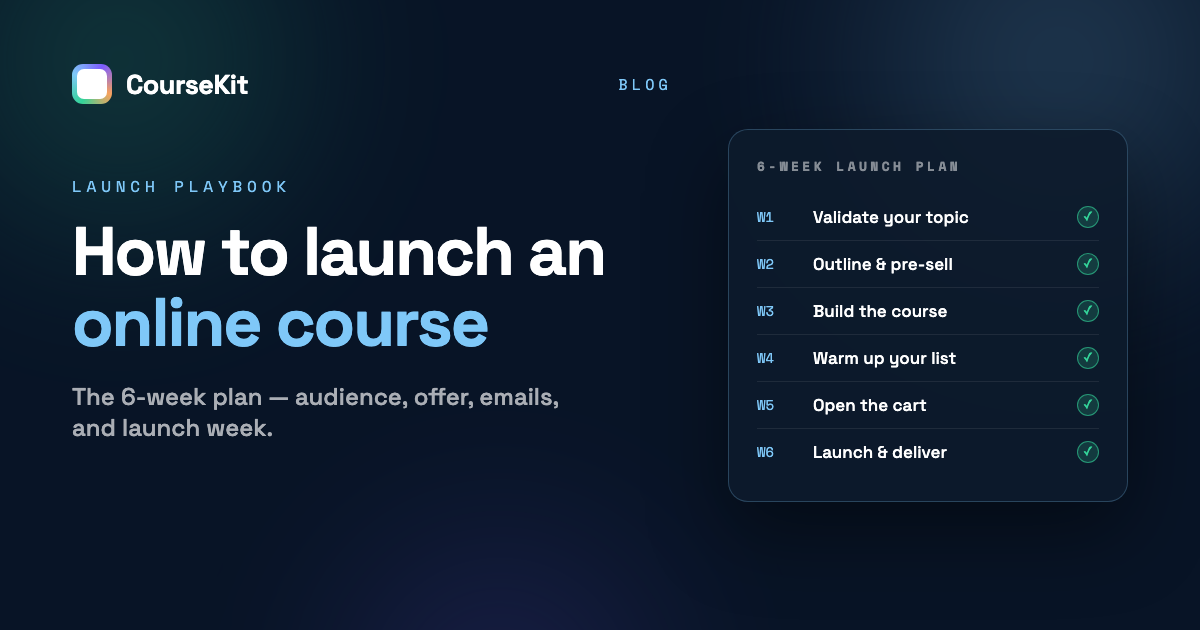
Launching an online course is a six-week project, not a publish button. The playbook below takes you from a validated idea to an open cart, week by week — including the waitlist mechanics, the exact email sequence, and the technical checklist most first-time launchers discover the hard way, mid-launch.
It assumes your course topic is chosen and at least partly built. If you are earlier than that, start with our step-by-step guide to selling online courses, then come back here for launch week.
Before the clock starts: three things you need
- An audience you can email. Social reach is rented; an email list is yours. Even a small list — 200 engaged subscribers — beats 20,000 passive followers for a launch, because email is where course sales actually close.
- A validated promise. At least a handful of real people should have told you — with pre-orders, survey answers, or discovery calls — that they want the specific outcome your course delivers.
- A home you control. Where your course lives shapes every launch asset. Selling from your own website keeps your branding, your URLs, and your audience relationship intact — rather than sending launch traffic to a platform’s subdomain where every page whisper-advertises someone else’s brand. (Our platform comparison covers the options honestly.)
The 6-week launch timeline
Week 1 — Lock the offer
Write the one-sentence transformation (“After this course, you will…”), decide the format (self-paced, cohort, or hybrid), and set the price and any launch discount now — not the night before cart opens. Pricing shapes your emails, your sales page, and your revenue math, so settle it first; our online course pricing guide walks through benchmarks and the fee math.
Week 2 — Finish the core, not the polish
Complete the modules that deliver the core promise. Resist perfecting every lesson: courses improve fastest after real students hit real sticking points. A launch needs a complete path to the outcome — it does not need all the bonus material you have imagined.
Week 3 — Open the waitlist
Publish a simple waitlist page: the transformation, who it is for, when doors open, and an email field. Then give people a reason to join beyond “be notified” — a genuinely useful lead magnet tied to the course topic (a checklist, template, or mini lesson). Announce it everywhere you have presence, and mention it in every piece of content you publish for the next three weeks.
Week 4 — Build the sales page
One page, one job. The structure that converts: outcome-focused headline, the pain and the promise, what is inside (framed as outcomes per module, not video counts), proof (testimonials, results, your credentials), price with any payment plan, a guarantee, and an FAQ that answers the real objections — time, tech skill, “will this work for me.” Write it in your voice; polish beats hype.
Week 5 — Warm up
Shift your content to the course’s themes: teach one genuinely useful piece of the material publicly, share your story or a student’s, and tell the waitlist doors open next week — including exactly when, what the launch offer is, and that it is limited (a real deadline or a founding cohort cap, never a fake one).
Week 6 — Open cart
Most launches run open enrollment for 5–7 days. Your only jobs: send the sequence below, answer every question personally and fast, and share proof as it happens (“14 founding members in…”). Do not launch new content this week — the launch is the content.
The pre-launch content calendar
If “post more” feels vague, this is the minimum effective schedule for the final month — one piece of public content and one email per week, each with a single job:
| Week | Public content | Email to your list | Job |
|---|---|---|---|
| W3 | Announce the course and waitlist, with the lead magnet | “Something is coming” + deliver the magnet | Start the waitlist |
| W4 | Behind-the-scenes of the build; an early student-style win | The origin story — why this course exists | Build belief |
| W5 | Teach one complete piece of the material, free | “Doors open Tuesday” — date, offer, and cap | Prime the open |
| W6 | A live Q&A or workshop mid-week | The 7-email sequence below | Convert |
Every piece points at the same place: the waitlist before cart open, the sales page after. If a post or email does not serve this launch, it waits until the week after.
The 7-email open-cart sequence
- Doors open (day 1): the transformation, who it is for, the founding offer, one clear button.
- The story (day 2): why this course exists — your journey or a student’s, ending at the offer.
- What is inside (day 3): walk the modules as outcomes; answer “what exactly do I get?”
- Objections, answered (day 4): the three real reasons they hesitate, addressed honestly — including who the course is not for.
- Proof (day 5): testimonials, early-student wins, your credentials. Borrowed belief closes fence-sitters.
- 48-hour notice (day 6): the deadline is real; restate offer and what disappears when it passes.
- Final hours (day 7, morning and evening): short, direct, zero new arguments — deadline, link, sign-off. Typically the highest-converting email of the week.
Expect roughly half of all launch revenue in the final 48 hours. That is normal buyer behavior, not a failing launch — hold your nerve and send the last emails.
Pick your launch model
- Founding-member beta. Best first launch. A smaller cohort at 30–50% off, bought into shaping the course, becomes your testimonial engine for the real launch.
- Live cohort launch. Fixed start date, enrollment window, students move together. Highest energy and price ceiling; repeat it each intake.
- Evergreen with a launch spike. Course stays purchasable year-round; you run 2–3 promotional pushes a year. Steadier, quieter revenue — usually the second-year model, after a live launch proves the offer.
Cart-open day, hour by hour
Day one sets the tone for the week — the momentum you create in the first twelve hours echoes through every email after. A schedule that works:
- Morning — the doors-open email. Send it when your list actually reads, not at midnight; for most audiences that is 8–10am in your buyers’ dominant timezone.
- Right after — update every surface. Bio links, pinned posts, community banners, your email signature. Anyone who encounters you today should trip over the launch.
- Midday — the first proof post. The moment founding members exist, say so publicly. Specific beats vague: “9 seats gone before lunch” outworks “going fast.”
- Afternoon — personal invitations. Write individually to the ten or twenty people who explicitly said they were waiting. One line, one question, zero pressure — these convert at rates mass email never touches.
- Evening — answer everything, then report. Clear every question and comment, then close the day with an honest status update. Tomorrow’s story email lands on a warmed audience.
The launch-week tech checklist
- Buy your own course with a real card at full price — the complete flow: checkout, receipt, welcome email, first lesson access. Refund yourself after.
- Test the failure paths: declined card, double-click on the buy button, coupon typos.
- Check every link in all seven emails, on the sales page, and in your bio links — on mobile.
- Confirm drip and access rules: if modules unlock over time, verify a new student sees exactly what they should on day one.
- Keep your domain consistent. Sales page, checkout, and course should live on the same domain you have been sending people to for weeks — domain switches at checkout cost trust precisely when trust converts. (This is the core of why we built CourseKit to run inside your own site.)
The numbers to watch
Useful planning baselines — rules of thumb creators commonly report, not guarantees: 1–3% of a warm email list buying during a first launch; 2–5% sales-page conversion from warm traffic; 30–40%+ open rates on launch emails to an engaged list. If 1% of your current list at your planned price disappoints you, grow the list or raise the price — before launch week, while both are still movable.
The week after: launch is not the finish line
What you do in the seven days after cart close determines whether this launch compounds into the next one.
- Onboard hard for 48 hours. Completion starts at enrollment: a welcome email with the first small win, a “start here” lesson, and a personal note to every founding student. Students who act in the first two days are the ones who finish — and finishers become testimonials.
- Catch the almost-buyers. Everyone who clicked toward checkout but did not buy gets one honest email: the course is closed, here is the waitlist for the next intake. That list opens your next launch warm.
- Collect proof while it is fresh. Ask early finishers of module one for a sentence about why they joined; ask again at completion for results. Save everything, with permission.
- Debrief the numbers. List conversion, sales-page conversion, per-email open and click rates, refund rate. Write them down — next launch’s targets are this launch’s baseline.
- Decide the bridge. Evergreen the course quietly between launches, or close it fully and stack demand for the next cohort. Either works; drifting between the two does not.
How to launch an online course: FAQ
How long should an online course launch take?
About six weeks of focused preparation with a 5–7 day open-cart window is the pattern that balances momentum against burnout. Compressed “launch in 5 days” approaches exist, but they assume an existing audience and a finished course.
Can I launch a course without an audience?
You can — to a much smaller result. With no list, run a founding-member launch to your personal network and one borrowed audience (a guest workshop, a podcast, a community you genuinely participate in), then treat the proceeds as proof for building the audience the real launch deserves.
Should my course be finished before I launch?
The core path to the promised outcome should be complete; bonuses and polish can follow. Cohort courses can legitimately sell before content is final — founding students often prefer shaping it.
What is the best day to open cart?
Convention favors opening Tuesday–Thursday, when inboxes are active, and closing on a Sunday or Monday night so the weekend can do deadline work. But the pattern matters less than your list’s behavior: open when your emails historically get read, and never let calendar theory delay a launch that is otherwise ready.
How many launch emails are too many?
Seven across an open-cart week to a warm list is well within tolerance — buyers deciding against a deadline expect the cadence. Unsubscribes will tick up on days six and seven; that is the list cleaning itself of people who were never going to buy, not a signal to stop. The real mistake is the opposite: two timid emails, half the revenue.
Should I discount if mid-launch sales are slow?
No — a surprise mid-launch discount punishes the people who trusted you first and teaches everyone else to wait next time. If the launch is soft, add value instead: a bonus workshop, an extra Q&A session, one more payment-plan option. Hold the price; fix the offer.
What should launch week cost me?
Potentially nothing beyond your platform’s monthly fee — unless your platform takes a percentage of sales, in which case launch week is exactly when that percentage bites hardest. Check what your infrastructure keeps from a strong launch before you open cart; our fee calculator makes the comparison concrete.
Six weeks from now, the difference between a quiet launch and a real one will trace back to unglamorous choices: the waitlist you opened in week three, the emails you actually sent, the checkout you tested with your own card. Start the clock, work the calendar above, and let the sequence do its job — then take what the numbers teach you into a bigger second launch.
Written by Dr. Hesham Mashhour, author of Start Your Online Course Business Today and founder of CourseKit — the course platform that runs inside your own Webflow site, with every feature on every plan and a transaction fee that falls to 0%. See what is included →