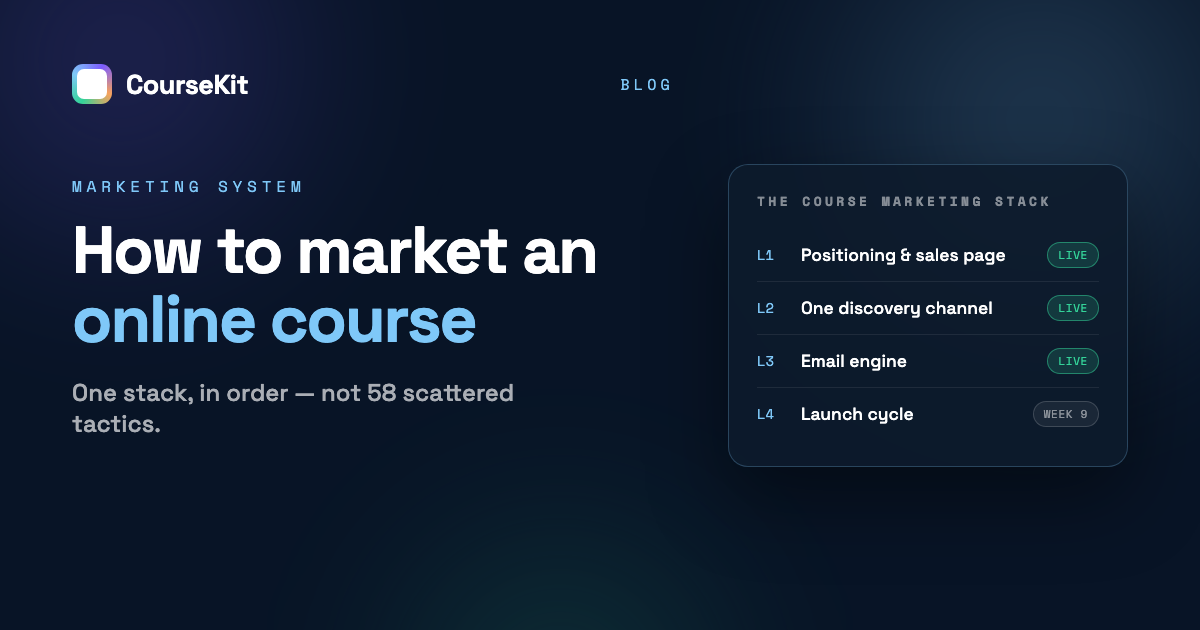
Search this topic and you will find guides listing 41, 50, even 58 ways to market an online course. They are not wrong — every tactic on those lists works for someone — but a pile of channels is not a plan, and trying six of them at once is the most reliable way to make none of them work. Courses get sold by a small system run consistently: a sharp position, one discovery channel, an email engine, and a repeatable launch cycle. This guide builds that system in order, tells you what to add as your audience grows, and ends with a 90-day plan you can start this week.
Why the “58 ways” approach fails
The big marketing listicles — Teachable catalogs 41 ideas, MailerLite 22, Thinkific 58 — are inventories, not strategies. They hand you every possible channel with no ordering, no dependencies, and no honest note about time-to-results. So new creators sprinkle effort across five platforms, see nothing compound anywhere, and conclude that marketing “doesn’t work” for them.
The truth is less glamorous: almost every course business that works runs the same four layers underneath, and the tactics on those lists are just interchangeable parts inside the layers. Build the layers in order and most tactical choices stop mattering very much.
The course marketing stack
Layer 1 — Positioning and a sales page that converts
Marketing amplifies your positioning; it cannot substitute for it. Before any promotion, be able to complete two sentences without hedging: “My course takes [specific person] from [current state] to [specific outcome]” and “It is different from the alternatives because [reason a buyer actually cares about].” If those sentences are mushy, every ad, post, and email built on them will be mushy too.
That positioning lives on a sales page with an outcome-focused headline, proof, price, and an FAQ that answers real objections — the full structure is in our launch playbook. Put that page on your own domain, not a platform subdomain: every link you earn from here on should be building your site’s authority, a point we will come back to.
Layer 2 — One discovery channel, chosen deliberately
Discovery is how strangers first find you. You need exactly one channel done well — a second channel earns you far less than doubling down on the first. Choose by fit, not fashion:
| Channel | Best if | Time to results |
|---|---|---|
| SEO / blogging | Your buyers search for the problem; you can write | Months — then it compounds |
| YouTube | The skill is visual; you are comfortable teaching on camera | Months — videos keep selling for years |
| Short-form social | Your niche lives there; you can post daily | Fast — but fleeting; every post dies in days |
| Borrowed audiences | You are starting from zero | Weeks — podcasts, guest workshops, communities |
If you have no audience at all, borrowed audiences are the honest answer: guest on podcasts your buyers already hear, run free workshops for communities they already trust, answer questions where they already ask them. You are trading your expertise for someone else’s distribution — the fastest legitimate trade in marketing.
Layer 3 — An email engine between discovery and sales
Discovery channels rent attention; email owns it. The engine has three parts, none optional. A lead magnet — a checklist, template, or mini lesson genuinely useful on its own — converts strangers into subscribers. A short welcome sequence (3–5 emails) delivers the magnet, tells your story, and shows what you sell. A regular value note — weekly or fortnightly, teaching something small — keeps the list warm between promotions.
This is the layer creators skip because it feels like plumbing. It is also where the sales actually happen: launches convert the list, not the feed. A modest list that opens your emails will outsell a large following that scrolls past you.
Layer 4 — A sales cycle you repeat
With the first three layers running, selling becomes a calendar, not a scramble: an open-cart week two or three times a year, each following the same rhythm — warm-up content, a genuinely useful live session, a 5–7 day window with a real deadline, and the 7-email sequence doing the heavy lifting. Between launches, the course can sell quietly in evergreen mode while testimonials from each cohort feed the next one’s sales page. Each cycle should leave you with three assets the last one didn’t have: more subscribers, more proof, and better numbers.
Making your one channel actually work
Choosing a channel is the easy half. The difference between a channel that compounds and one that merely keeps you busy is whether each week’s effort leaves behind an asset that keeps working after you log off.
- If you chose SEO: build a small cluster, not scattered posts — four to six articles answering the questions your buyers actually search, all linking to one course-adjacent money page. One honest comparison or “best tools for X” page usually outearns five diary posts, because it catches buyers rather than browsers.
- If you chose YouTube: make search-first videos — titles that match what beginners type, not clever titles that need your fame to work. One flagship tutorial that fully teaches a small win will keep recruiting subscribers for years; put the lead magnet in the description and the pinned comment.
- If you chose borrowed audiences: systematize the pitch. A two-line email — who you help, the specific topic you can teach their audience, one link proving you can talk — sent to six podcasts or communities a month, with one follow-up a week later. Most yeses arrive on the follow-up.
- If you chose short-form: batch and repurpose. One teaching idea becomes a script, three cuts, and a text post, produced in a single sitting each week. Consistency beats production value on every algorithm.
Then give the channel ninety days of weekly output before judging it. Channel-hopping resets the compounding clock every time — the creators who seem to be everywhere almost always started with one channel that worked, and expanded from strength.
What to add at each stage
The stack stays the same; the emphasis moves as you grow:
| Stage | Focus | What to add | What to ignore |
|---|---|---|---|
| 0–500 subscribers | Borrowed audiences + founding launch | Lead magnet, welcome sequence, 2 podcast guest spots a month | Paid ads, being on every platform |
| 500–5,000 | Your discovery channel + launch rhythm | Consistent publishing, webinar launches, referral asks | New channels before the first compounds |
| 5,000+ | Conversion and scale | Evergreen funnel, carefully tested paid ads, affiliate partners | Anything that only you can do manually forever |
The compounding advantage of your own domain
Here is the structural decision hiding under all of this: where does your marketing equity accumulate? Every guest post that links to you, every course page Google indexes, every student who shares a lesson — each one either strengthens a domain you own or a subdomain your platform owns.
When your courses live at hosted-platform.com/your-school, your content marketing builds their authority; if you ever leave, the equity stays behind. When courses are real pages of your own site, the blog that attracts readers, the sales pages that earn links, and the course catalog itself all stack authority on one domain — and that advantage compounds for years. It is the quiet reason we built CourseKit to run inside your own Webflow site, and a factor worth weighing in any platform comparison — whichever tool you choose.
Eight tactics that punch above their weight
- A two-minute preview video. Buyers want to sample your teaching before trusting you with hours of it. One well-made preview outperforms pages of copy.
- A testimonial engine, not testimonial luck. Ask at the moment of a student’s first win — not months later. One sentence about why they joined, one about what changed.
- A free mini course as your lead magnet. It demonstrates the product while building the list — double duty no PDF can match. (Run it on your Free plan; it costs nothing.)
- Podcast guesting with a destination. Every appearance should point at a dedicated landing page with the lead magnet — never just your homepage.
- Answer questions in public. Twenty genuinely helpful answers in the right community outmarket a hundred promotional posts.
- A referral nudge. Happy students will recommend you if asked at completion — a simple “give a friend 20%, get a bonus session” note in the final lesson is enough.
- SEO basics on the sales page. A title that matches what buyers search, an FAQ section answering real questions, fast load. Boring, free, durable.
- Links everywhere you already are. Email signature, bio pages, video descriptions, community profiles. Zero-effort impressions add up.
Three things to skip until later
- Paid ads before conversion proof. Ads amplify whatever exists — including a sales page that doesn’t convert. Earn organic sales first, then buy more of what already works.
- Every channel at once. Each platform demands its own format, cadence, and skills. Sprinkled effort compounds nowhere.
- Discount-led marketing. If every promotion is a sale, your list learns to wait. Market the outcome and the deadline, hold the price — the math is in our pricing guide.
Your first 90 days
| Weeks | Build | Done when |
|---|---|---|
| 1–4 | Positioning sentences, sales page, lead magnet, welcome sequence | A stranger can find, understand, and join your list |
| 5–8 | Discovery: pitch 6 podcasts or publish 4 pieces on your channel; email your list weekly | Subscribers arriving every week without being pushed |
| 9–12 | First (or next) launch: warm-up content, live session, open cart | A launch debrief with real numbers to beat next cycle |
Then repeat, with better numbers each cycle. That is the whole system — unglamorous, ordered, and it compounds.
How to market an online course: FAQ
How do I market an online course with no audience?
Borrow audiences: guest on podcasts your buyers hear, run free workshops for communities they trust, and answer questions where they already gather — each pointing at a lead magnet. Then sell a founding cohort to the small list you build. Our launch playbook covers that first launch step by step.
When should I start marketing my online course?
Before the course is finished. The waitlist opens in week three of a standard six-week launch, while the course is still being built — and the positioning work in Layer 1 should precede recording entirely, because it shapes what you record. Audience-first creators simply reverse the order: they grow the list with a lead magnet first and let subscriber questions shape the curriculum. If your course is already done, start today — the email engine takes days to assemble, and borrowed audiences can be booked within a month.
What is the most effective marketing channel for online courses?
Email, by a wide margin — but email is where sales close, not where strangers find you. The right question is which discovery channel fits your buyers and your skills; feed whichever you choose into an email list, and let the list do the selling.
How much should I spend on marketing an online course?
You can run the entire stack in this guide for roughly the cost of an email tool — positioning, borrowed audiences, email, and launches are effort, not budget. Introduce paid spend only after organic sales prove the page converts, and mind your platform’s cut when you do: ad margins are exactly where a percentage transaction fee hurts most.
How long does course marketing take to work?
Borrowed audiences can fill a founding cohort in weeks. Owned channels are slower: consistent SEO or YouTube typically needs months before compounding kicks in. The 90-day plan above is calibrated to produce a real launch — not passive income — in one quarter.
Do I need social media to sell online courses?
No. Plenty of course businesses run on search, email, and partnerships alone. Social is one discovery option among several — useful if your buyers genuinely live there and you can sustain the cadence, optional otherwise.
Written by Dr. Hesham Mashhour, author of Start Your Online Course Business Today and founder of CourseKit — the course platform that runs inside your own Webflow site, with every feature on every plan and a transaction fee that falls to 0%. See what is included →