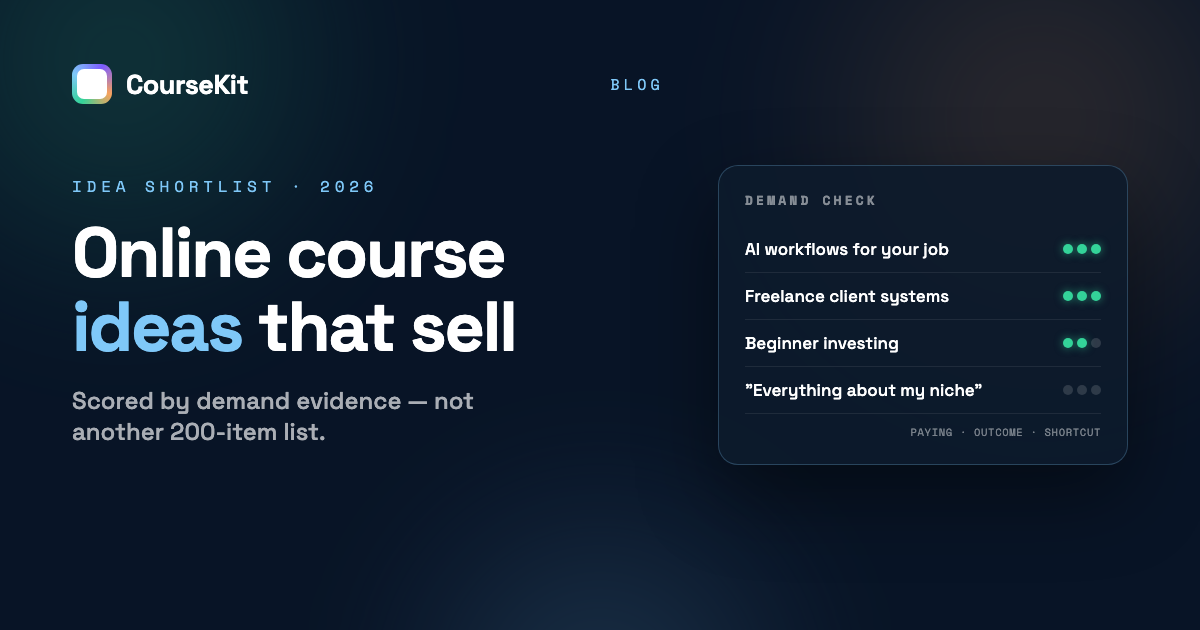
Most “online course ideas” articles are idea dumps — 20, 50, sometimes 270 topics in a wall of bullet points. The problem is that an idea list cannot tell you the only thing that matters: whether anyone will pay for it. A course on a topic nobody spends money on fails no matter how well you teach it, and a mediocre course in a proven market can still find buyers.
So this list works differently. Every idea below passed a three-signal demand test, each comes with the evidence that people already pay in that market, and each gets a realistic price band drawn from our course pricing research. At the end: how to score your own idea with the same test, and what to do before you record a single lesson.
The three-signal demand test
Borrowed from our guide to selling online courses, a course topic is worth building only when all three signals are present:
- Paying: people already spend money on this problem — competing courses, coaches, books, or tools exist. Competition is proof of a market, not a reason to run.
- Outcome: there is a clear before-and-after you can promise in one sentence. “Understand marketing better” is not an outcome; “write a cold email that gets replies” is.
- Shortcut: your course compresses months of trial and error into weeks. If you cannot shortcut the path, it is a blog post, not a product.
Every idea below carries all three signals. What none of them carry is a guarantee — the test tells you a market exists, and your positioning, audience, and teaching decide the rest.
AI & technology skills
The hottest demand of 2026 — and the fastest-moving, so ideas here reward teachers who keep material current.
- AI workflows for a specific profession. Not “AI for beginners” — pick one job: AI for accountants, for real-estate agents, for teachers, for paralegals. Employers and freelancers are actively paying to not fall behind, and specificity is your moat against free YouTube content. $100–$400.
- Prompt & automation systems for small business. Owners will pay to replace repetitive admin with AI-assisted workflows they control. $150–$500.
- No-code app building. Bubble, Glide, and friends — buyers want a shipped product by the final module, which makes the outcome beautifully concrete. $100–$300.
- Data basics for non-analysts. Spreadsheets-to-dashboards for managers who are asked for numbers weekly. Corporate buyers make this one resilient. $80–$250.
- Cybersecurity hygiene for small teams. Insurance requirements and horror stories drive real spending. $150–$400.
Business & freelancing
Careers and income are the classic high-stakes category — buyers here calculate ROI, which supports higher prices.
- Freelance client systems. Finding, pricing, and keeping clients in one niche (design, writing, development). With a majority of new workers considering freelancing, the buyer pool keeps refilling. $150–$500.
- Productized services. Turning a custom service into a fixed-scope, fixed-price offer — agency owners and burned-out freelancers pay premium prices for this transformation. $300–$1,000.
- Start a [specific] business. The narrower the better: a cleaning company, a bookkeeping practice, an Etsy print shop. Specific startup playbooks outsell generic entrepreneurship every time. $150–$600.
- LinkedIn-based selling for consultants. Consultants already spend heavily on lead generation; teaching them an organic system taps an existing budget. $200–$700.
- Career transitions. Landing a first PM/UX/data role, or the mid-career pivot. Job outcomes justify serious prices — with proof. $200–$800.
Money & finance
High emotional stakes and lifelong relevance — but check your jurisdiction's rules before giving anything resembling financial advice.
- Beginner investing frameworks. Index-fund basics, retirement accounts, the boring-but-right fundamentals. Enormous evergreen search demand. $50–$200.
- Budgeting systems that stick. The outcome — “a month where your money did what you planned” — is concrete and testimonial-friendly. $30–$150.
- Money operations for freelancers. Irregular-income budgeting, quarterly taxes, retirement without an employer. Underserved and growing. $100–$300.
- First rental property. Real-estate buyers are accustomed to paying for education; a sober, numbers-first course stands out in a hype-heavy market. $300–$1,000.
Creative skills
Passion buyers, video-friendly, endless niches — prices are moderate but volume and community potential are strong.
- Procreate / digital illustration. The tool-plus-style combination (“character art in Procreate”) keeps this perennial fresh. $50–$200.
- Watercolor, pottery, calligraphy — with a finished piece. Frame the course around completing one portfolio-worthy piece, not “learning techniques.” $40–$150.
- Phone videography for small business owners. Business buyers, concrete outcome (a month of content), modest gear. $100–$300.
- Music production in one genre. “Finish your first lo-fi track in Ableton” beats “learn music production.” $80–$300.
- Writing that sells — for one format. Email newsletters, case studies, or video scripts. Writers pay when the format connects to income. $100–$400.
Health, wellness & lifestyle
Motivated buyers and strong community dynamics — mind certification requirements in regulated areas.
- Strength training for a specific population. Over-50s, postpartum, desk workers, runners. The population is the product. $50–$200, or $20–$40/mo as a membership.
- Meal prep systems for busy families. Recurring problem, visual proof, natural fit for a membership with fresh monthly plans. $30–$100, or membership.
- Sleep, focus, or stress systems for professionals. Employers increasingly reimburse these — concrete protocols beat vague wellness. $80–$250.
- Dog training by problem. Reactivity, recall, puppy first-year. Pet spending survives every economic cycle. $50–$200.
Teaching what you already do
The most overlooked category: package the process you already run at work.
- Your professional process, productized. How you run discovery calls, onboard clients, plan sprints, close deals. Peers in your field are the easiest audience to reach — you already speak their language. $150–$500.
- Compliance and certification prep in your industry. Where a credential or audit looms, education budgets exist. Dry topics, reliable demand. $100–$400.
- Tool mastery for your niche. The advanced course for software you use daily — Notion for agencies, Excel for finance teams, Webflow for freelancers. $80–$300.
- Train-the-team courses. Sell the course you would teach a new hire — to other companies' new hires. B2B pricing, multi-seat sales. $300–1,000+ per team.
How to pick yours (in one evening)
Do not pick the “best” idea from this list — pick the one where your unfair advantage overlaps with demand. Write three columns: what you can teach better than most people, what each candidate audience already pays for (search the competing courses — their existence is your evidence), and which audience you can actually reach. The idea that appears in all three columns wins — even if a “hotter” topic sits in column two alone. A modest topic you can reach and teach beats a trending topic where you have no edge and no audience.
Then sharpen it with the specificity rule: whatever you picked, narrow it once more. “Yoga” becomes “yoga for runners”; “Excel” becomes “Excel for property managers.” Broad courses compete with the whole internet; narrow ones compete with nobody.
A worked example: the exercise in action
Watch the three columns pick a winner. Dana is a project manager at a construction firm who is also a decent amateur photographer and once built the company’s Notion workspace.
Column one — can teach well: construction project management, Notion systems, beginner photography. Column two — markets that pay: photography courses exist by the thousand (strong demand, brutal competition from free content); Notion templates and courses sell steadily; construction PM certification prep sells at serious prices because careers depend on it. Column three — can reach: Dana knows nobody in the photography world, has a modest Notion-Twitter following, and knows hundreds of construction professionals through work, two industry groups, and a LinkedIn network that actually replies.
Photography dies in column three. Notion survives everywhere but pays modestly and competes broadly. Construction PM — specifically “the scheduling and documentation system for new construction PMs” — appears strongly in all three columns and lands in the highest-stakes price band on this page. That is the course, even though it was the least glamorous idea on Dana’s original list. The exercise works precisely because it disqualifies ideas your enthusiasm would have kept alive.
Validate before you build
The list got you a candidate; only money validates it. Before recording anything: describe the course in one outcome sentence, put up a simple page, and pre-sell it — a founding-member discount, a waitlist people actually join, or ten direct conversations that end with “when can I buy?” Our launch playbook walks the full six-week sequence, and the marketing system covers finding those first hundred people.
One structural note while you are choosing: wherever the course lives, the topic authority you build — the blog posts, the course pages, the links — should accumulate on a domain you own, not a platform’s subdomain. That decision outlasts every topic trend on this page. (It is the problem CourseKit exists to solve, and its Free plan makes it a zero-cost place to validate.)
Online course ideas: FAQ
What online course topics are most profitable in 2026?
Categories where the outcome connects to income or high emotional stakes: AI skills applied to specific professions, freelancing and business systems, career transitions, and personal finance. Profitability follows the stakes of the problem more than the popularity of the topic.
Are AI course topics already oversaturated?
“AI for beginners” is — it competes with every platform, publication, and free video on the internet. “AI for [your profession]” is not, because the moat is the profession, not the technology: a paralegal trusts a course by someone who knows their documents and their compliance rules over a generic prompt guide every time. Saturation lives at the general level; demand lives in the specific.
Can I make money with a course in a small niche?
Often more easily than in a big one. A course for 2,000 reachable people with a painful problem outperforms a course for 2 million people you cannot reach. Niche courses also support higher prices because they speak directly to their buyer — and they are far easier to rank for in search.
What if my course idea already exists?
Good — that is demand evidence, not a locked door. Differentiate on audience (the same skill for a narrower group), on format (cohort where everything else is self-paced), or on outcome (a finished portfolio piece where others teach theory). You need an angle, not an empty market.
How do I know if my course idea will sell before building it?
Pre-sell it. A founding cohort at a discount, a waitlist that grows without pushing, or ten conversations where real people ask to buy — any of these beats keyword research. If nobody bites on the promise, the course would not have sold either; you just saved three months.
Should my first course be a mini course or a flagship?
A mini course is the faster test: one specific win, priced $27–$147, built in days. If it sells and students finish, expand the same topic into a flagship. Starting flagship-first works when you already have an audience asking for depth — our pricing guide covers both paths.
Written by Dr. Hesham Mashhour, author of Start Your Online Course Business Today and founder of CourseKit — the course platform that runs inside your own Webflow site, with every feature on every plan and a transaction fee that falls to 0%. See what is included →